Haiquan Lu, Gongfan Fang, Xinyin Ma, Qi Li, Xinchao Wang
National University of Singapore
ICML 2026

Abstract

Reasoning models enhance performance by tackling problems in a step-by-step manner, decomposing them into sub-problems and exploring long chains of thought before producing an answer. However, applying extended reasoning to every step introduces substantial redundancy, as sub-problems vary widely in difficulty and complexity: a small number of pivotal steps are genuinely challenging and decisive for the final answer, while many others only involve straightforward revisions or simple computations. Therefore, a natural idea is to endow reasoning models with the ability to adaptively respond to this variation, rather than treating all steps with the same level of elaboration. To this end, we propose MixReasoning, a framework that dynamically adjusts the depth of reasoning within a single response. MixReasoning enables fine-grained mode switching by training a lightweight concise LoRA adapter and controls its strength to trigger switches based on reasoning difficulty estimated from sliding-window token confidence, yielding human-like transitions between fast and slow reasoning. The resulting chain of thought then becomes a mixture of detailed reasoning on difficult steps and concise inference on simpler ones. Experiments on AIME24, MATH-500, GPQA, and GSM8K demonstrate that MixReasoning shortens reasoning length by 13%-49% across benchmarks of varying difficulty, delivering consistent efficiency gains while maintaining performance.

Compare with Previous Methods
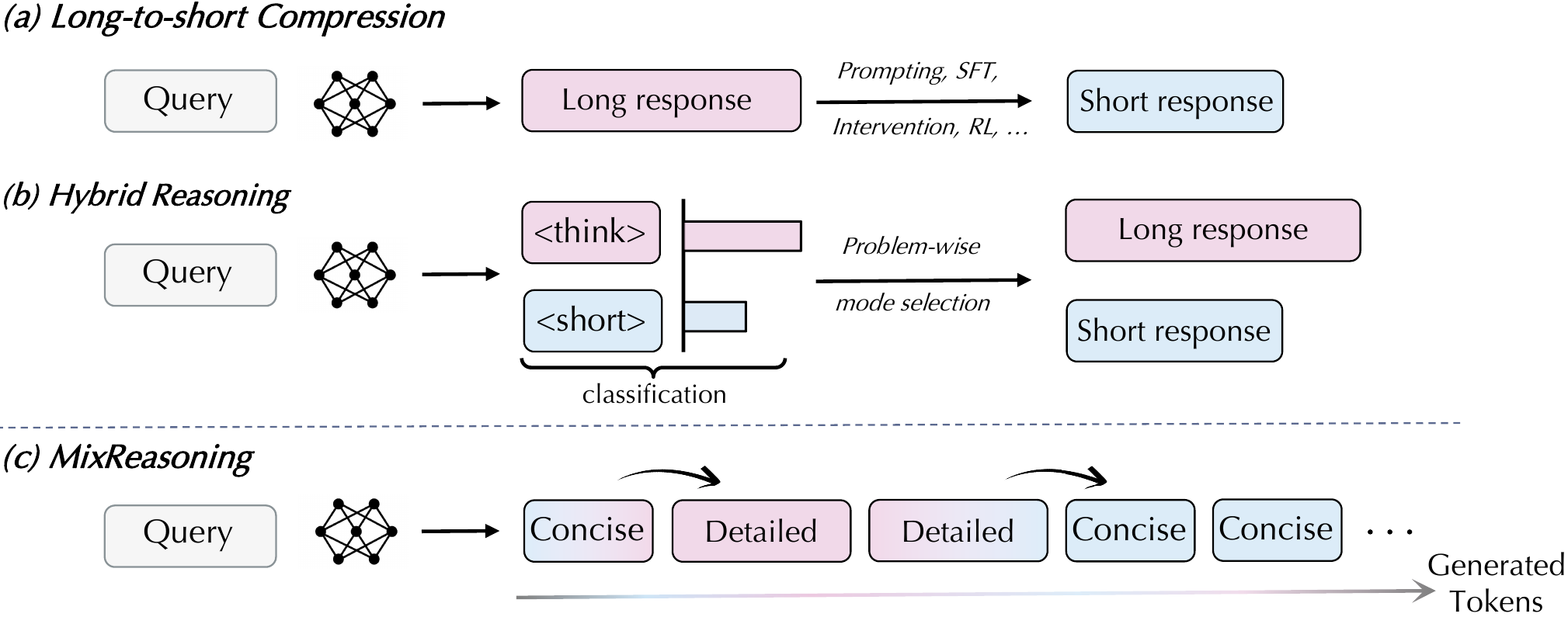
Comparison of long-to-short compression, hybrid reasoning, and MixReasoning, which switches between concise and detailed modes inside one response.
Long-to-short methods compress the entire response uniformly and may remove pivotal reasoning steps, while hybrid reasoning selects one mode for the whole problem. MixReasoning instead switches between concise and detailed reasoning within a single response according to local uncertainty.

Pipeline

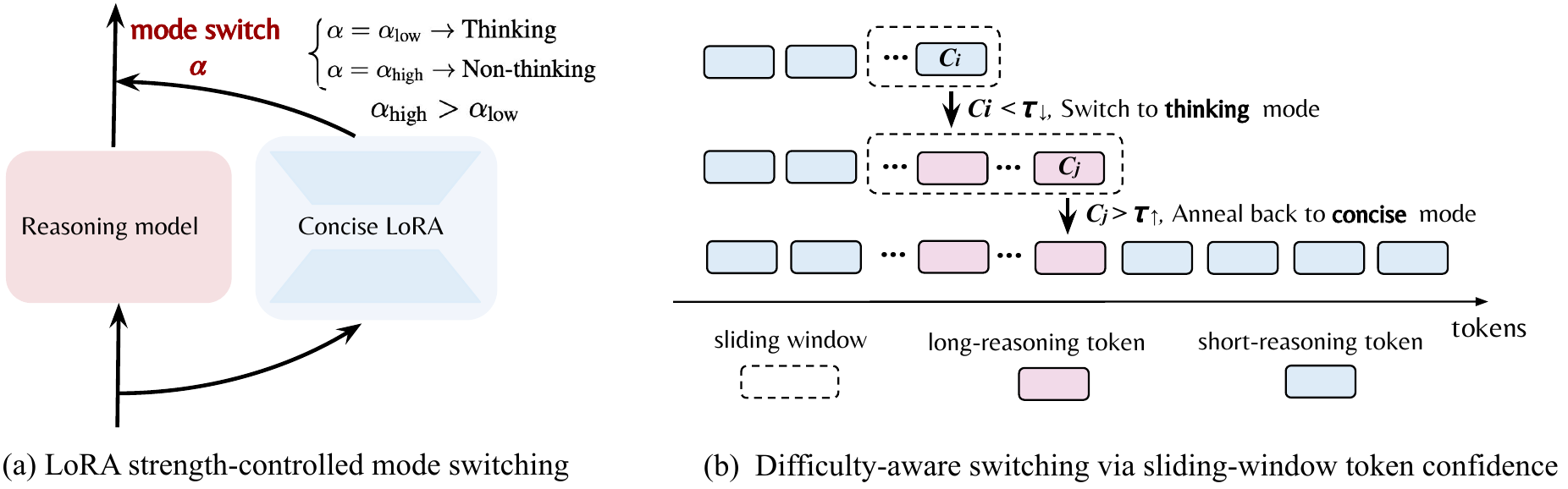
MixReasoning pipeline with LoRA strength-controlled mode switching and sliding-window confidence-based difficulty detection.
A concise LoRA adapter is attached to a base reasoning model, and its strength is scaled during inference to interpolate between detailed and concise reasoning. Sliding-window token confidence estimates local difficulty: low-confidence segments trigger thinking mode with one-window rollback, while confidence recovery returns generation to concise mode through a hysteresis controller.

Sliding-window Token Confidence Distribution
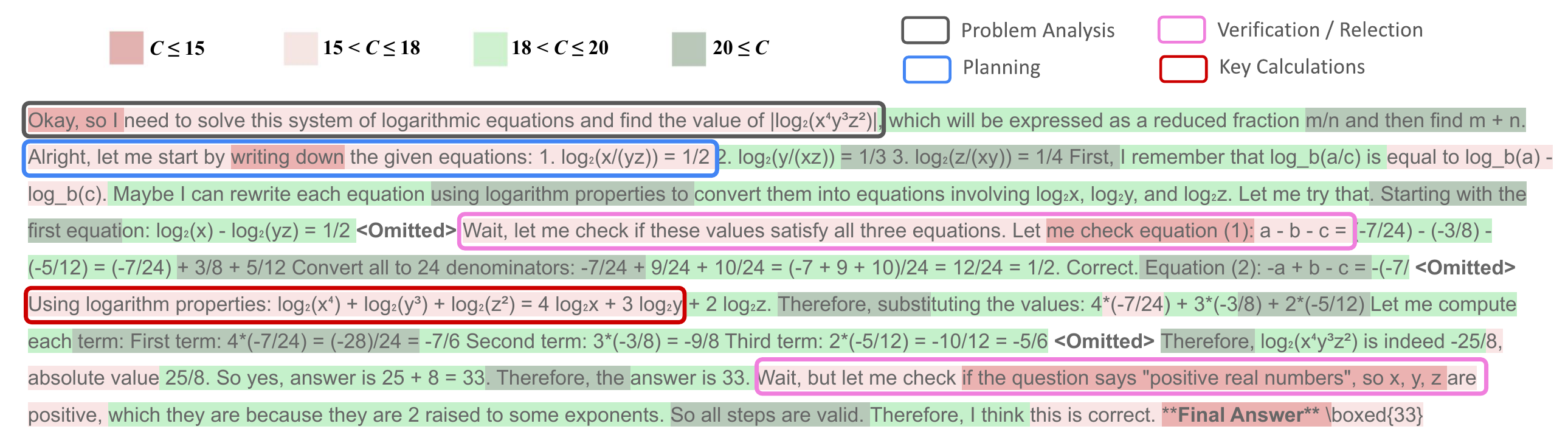
Qwen3-8B reasoning trace colored by sliding-window confidence, with analysis, planning, verification, and calculation regions highlighted.
Sliding-window token confidence in Qwen3-8B outputs. Low-confidence windows concentrate on analysis, planning, verification or reflection, and key calculations, whereas high-confidence regions largely correspond to routine execution, summarization, and straightforward logical follow-through.

Main Experiments

We compare MixReasoning with the original reasoning models and fixed concise modes on AIME 2024, GPQA-Diamond, MATH-500, and GSM8K. All results report mean Pass@1 and average generated tokens over five independent runs.
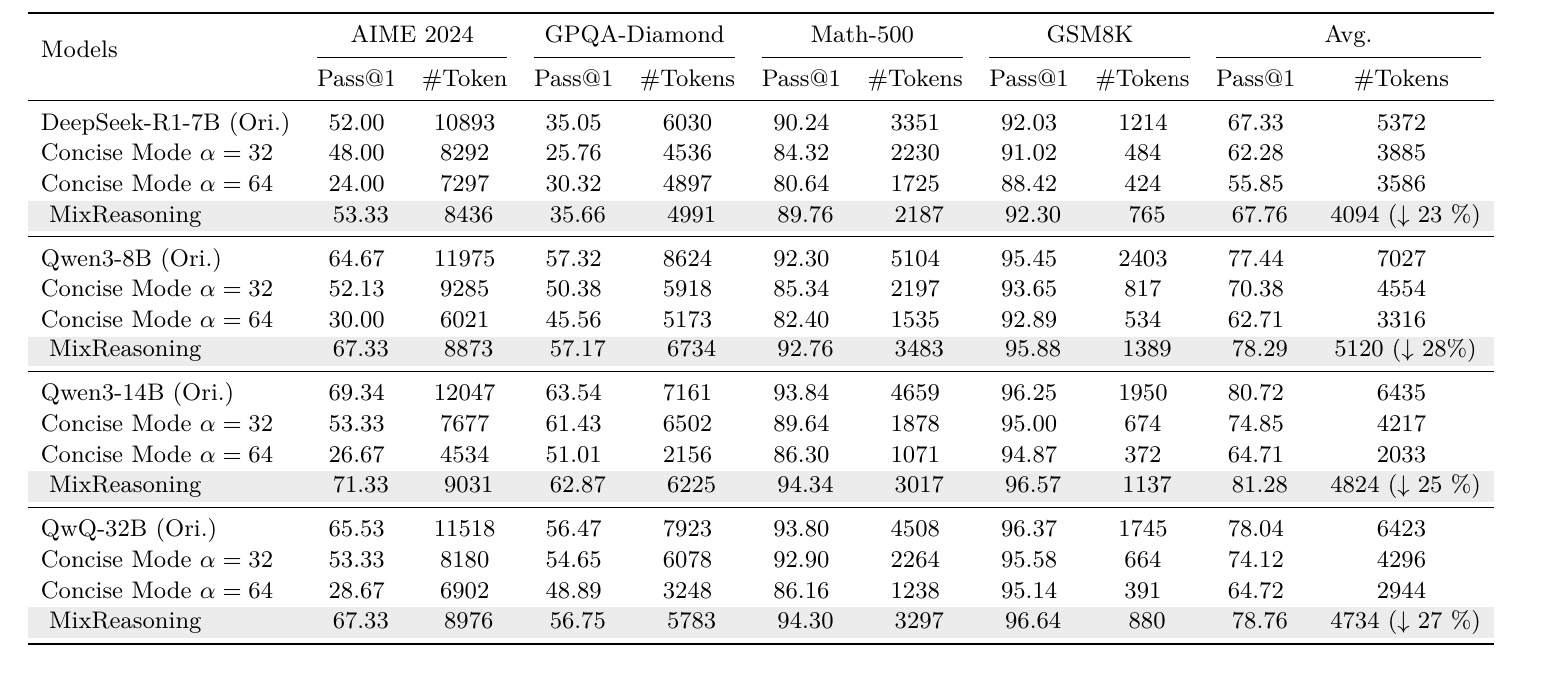
Main experiment table comparing original, fixed concise, and MixReasoning results across four model backbones and four reasoning benchmarks.
Across four reasoning backbones, MixReasoning consistently reduces generation length while matching or improving average Pass@1. The paper reports average token reductions of 23%-28%, with benchmark-level reductions ranging from 13%-49%.

Ablation Study

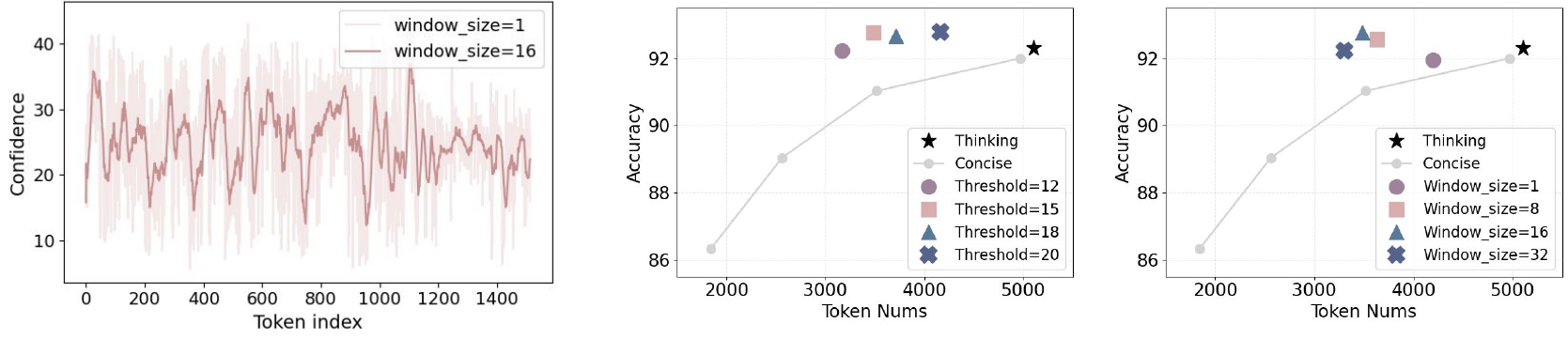
Ablation plots for token confidence smoothing, switching thresholds, and sliding-window size on Qwen3-8B and MATH-500.
Ablation of MixReasoning switching hyperparameters on Qwen3-8B and MATH-500. Increasing the low threshold allocates more tokens to thinking mode and provides a controllable accuracy-efficiency trade-off. Sliding-window averaging is substantially more stable than single-token confidence, with a window size of 16 used in the main experiments.

Acceleration

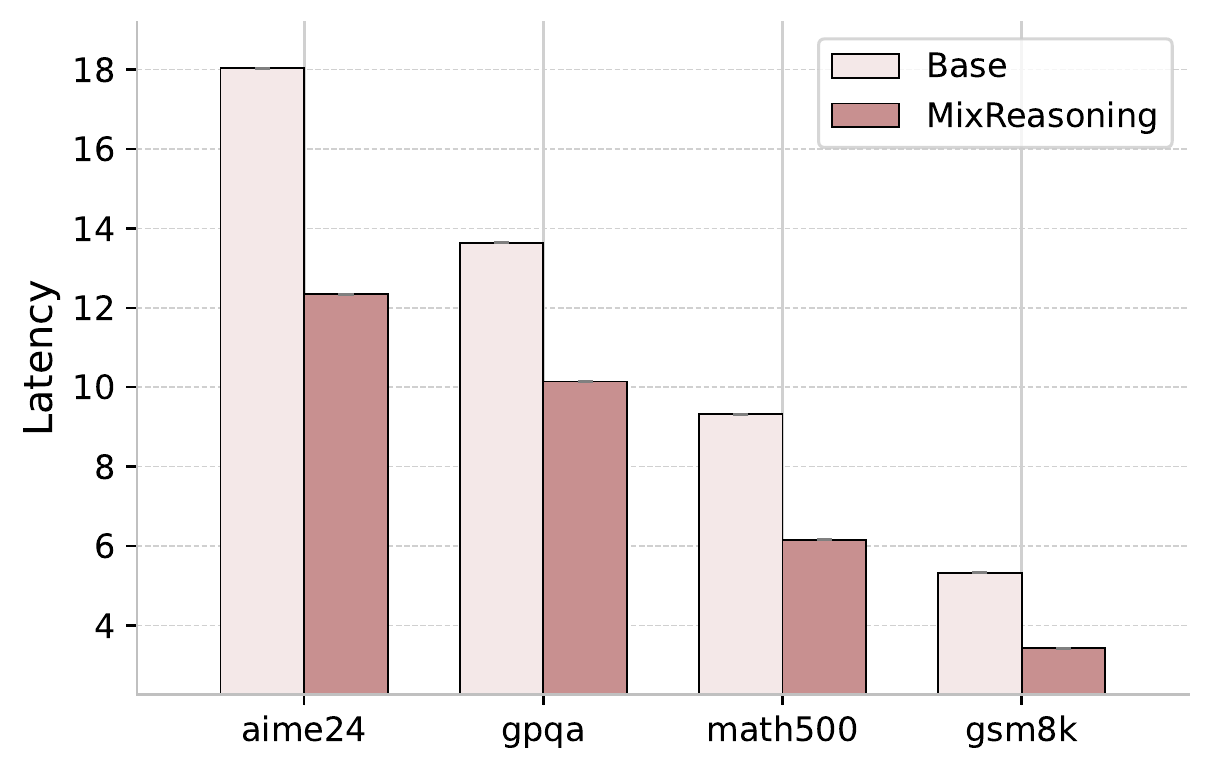
End-to-end latency comparison between the Qwen3-8B base model and MixReasoning on four benchmarks.
End-to-end latency of Qwen3-8B on AIME24, GPQA-Diamond, MATH-500, and GSM8K, measured with vLLM and averaged over five runs. Despite mode-switching operations, MixReasoning consistently reduces latency because the savings from shorter generation outweigh the small KV-cache prefill overhead.

BibTeX

@inproceedings{lu2026mixreasoning,
  title     = {MixReasoning: Switching Modes to Think},
  author    = {Lu, Haiquan and Fang, Gongfan and Ma, Xinyin and Li, Qi and Wang, Xinchao},
  booktitle = {Proceedings of the 43rd International Conference on Machine Learning},
  year      = {2026}
}